Saturday, January 23, 2010

Australian Kelpie


A Highly Prized Sheep Dog
The Australian Kelpie is a working breed that originated in Australia. They were bred to work with sheep having little or no guidance, making them highly prized among farmers and ranchers. Today Australian Kelpies have been imported throughout the world and their charges have expanded to include cattle, goats, ducks, chickens, and other livestock.


Appearance

Australian Kelpies are medium-sized dogs that stand between 17-20 inches and weigh in at 25-45 pounds. They have prick ears and a medium length tail that is low set. Their double coat is weather resistant, short, and dense. Colors of the Australian Kelpie include black or red that may or may not have tan, fawn, chocolate, and blue

History


The history of the Australian Kelpie begins in the late 1800s, when old Collies (not to be confused with today’s breeds) were imported to Australia from England for livestock work. One of these dogs was crossed with a back and tan female from New South Wales with the name of Kelpie. She was named after the mythological water horse from Celtic folklore, and her pups became the bases for the breed. Legend states that her father was a Dingo, or that there is at least Dingo in her bloodline. Whether or not this is the case, it is generally accepted that Dingos were added to the strain at some point to create the Australian Kelpie.

Temperament

Australian Kelpies are loyal, intelligent, friendly, and truly excel at the tasks they were bred for. These dogs are agile as well, and this mixed with their intelligence allow them to excel in agility and other dog sports. When working they use an “eye”, much like the Border Collie, but will also nip at the heel of more stubborn cattle, just as an Australian Cattle Dog would. Another clever trick they will utilize is if a flock of sheep is packed together in a tight location and they need to get to the other side, these dogs will jump on the back of the nearest sheep and run across the top of the flock. This breed can be kept as companions, but will need to be stimulated. Bored Australian Kelpies may become frustrated and in turn become destructive.

Health and Care

The Australian Kelpie is not suited for apartment life. They need room to roam for them to remain happy and content. If not working they need long walks daily and a busy owner that can keep up with them.

Generally a healthy breed the Australian Kelpie suffers from little genetic problems. They are prone to Progressive Retinal Atrophy, which can lead to blindness. Their life expectancy is around 12 years.

The coat of the Australian Kelpie requires only the occasional brushing. They are average shedders.

Australian Cattle Dog


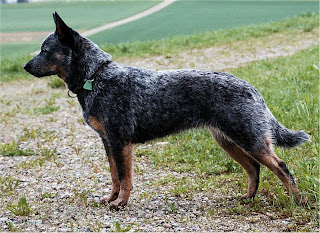
The Queensland Heeler

The Australian Cattle Dog is a herding dog that is breed for driving and controlling cattle. They were developed in Australia solely for this purpose, the result of six decades of cross breeding. Today the Australian Cattle Dog, or ACD, is still extremely popular with farmers and ranchers worldwide.


Appearance

Australian Cattle Dogs are a muscular and compact breed. They stand between 17-20 inches and weigh in at 35-45 pounds. Their double coat is weather-resistant and short, and has two varieties, red and blue, giving them the common nicknames of Red or Blue Heeler. These coats are not solid, but rather a “speckled” appearance, caused by a mottling of all the colors in their fur. Other marking can occur, for Blue Heelers they can have black, blue, or tan markings on the head, as well as tan on the legs, breast, throat, and jaws. Red Heelers can have darker read markings on their head, and are preferred to be even. Some Australian Cattle Dogs have a stripe of white hair on their foreheads, similar to a blaze on a horse; this is known as a Bentley Mark.

History

The development of the Australian Cattle Dogs began in the 19th century when Europeans began to settle Australia. A dog known as the Smithfield was brought alongside these pioneers to work their cattle, but they were a bit noisy, and above all did not adapt well to the climate. The Smithfield was crossed with the Dingo, and this cross became known as the Timmins Biters. During this same time the now extinct Old Smooth Collie were also being bred to the Dingo for herding sheep, leading to a mix referred to as the Hall’s Heeler. These two mixes, along with the added blood of the Bull Terrier, Australian Kelpie, and Dalmatian, eventually brought us the Australian Cattle Dog we know today.

Temperament

Australian Cattle Dogs are highly intelligent, full of energy, and known to have a bit of an independent streak. Like most herding dogs, they are highly active both in energy and mind. They need plenty of exercise, and if they do not have a working job to do, can turn destructive. This breed excels at dog sports, and it gives them the stimulation needed to be happy in a non-working environment. In absence of a true charge, such as cattle or sheep they may herd anything from birds, other dogs, or people, even without instruction. This is not an ideal breed for homes with children, and some individual dogs can be nippy. They tend to get along well with other dogs it is familiar with, but can turn aggressive towards unknown animals. By nature the Australian Cattle Dog is wary, which makes it an excellent watchdog.

Health and Care

The Australian Cattle Dogs are generally a healthy breed, and their life expectancy is around 12 years. They are prone to deafness, Progressive Retinal Atrophy, which can lead to blindness, and hip/elbow dysplasia.

Australian Cattle Dogs do not adapt well to apartment life. They need at least a large yard with room to roam, daily walks, and something to stimulate them mental if they are not working dogs. This breed retains many Dingo traits, and will prefer the outdoors, even on a cold night. Some dogs are even known to dig or burrow themselves a den, rather than sleep in their doghouse.

The coat of the Australian Cattle Dog requires little grooming. They should be brushed regularly and shed their coat twice per year.

Argentine Dogo


Argentina’s Hunting Dog


The Argentine Dogo is a large, muscular dog that was developed in the South American country of Argentina for big game hunting. Unfortunately throughout the years it has also become a well-known fighting dog. This has led to the Argentine Dogo to be an illegally owned pet in various parts of the world, such as the United Kingdom.

Argentine Dogos are large, white, short-coated dogs with highly muscular bodies. At the minimum height males stand at 24 inches at the withers, while the females stand at 23 inches, however the maximum height can reach as tall as 27 inches. Ears are sometimes cropped, but will also be left to hang naturally.

Argentine Dogos are normally evaluated as hunting dogs, and continually bred for the same results. In the 1920s an Argentine man by the name of Antonio Martinez started breeding a dog for the roles of pet, family guardian, and hunting dog capable of taking on large game such as wild boar and jaguars. Martinez started with the now extinct Cordoba Fighting Dog as his base for the breed. This bred was known to be a large ferocious hunting and fighting dog. Later the dogs were crossed with many breeds, which include, but are not limited to, the Great Dane, Boxer, Spanish Mastiff, and Irish Wolfhound. Martinez continued his selective breeding until the first standard for the Argentine Dogo was written in 1928.

The Argentine Dogo was specifically bred to avoid the dog aggression problems that were found in the Cordoba Fighting Dog, one reason being its inability to hunt in a pack. Unfortunately, these dogs are now being bred by many for the sole purpose of dog fighting. These dogs will continue fighting despite substantial injury, making them highly sought after for this purpose. The Argentine Dogo has even been imported to the United States for dog fighting as well, where it is illegal.

Argentine Dogos are loyal and affectionate with their families. They do well with children because of their high pain tolerance and are protective of their territory and people without fear. Dogs get along well with other pets as long as they have been socialized by a young age. Any type of aggression is not desirable within the Argentine Dogo, despite the breeding that is being done by dog fighting rings.

Monday, January 18, 2010

Ardennes Cattle Dog


Bouvier des Ardennes

Bordering on Extinction
The Bouvier des Ardennes is a working dog from the European country of Belgium. The breed was actually believed to be extinct, and was listed as such by the Belgian Kennel Club. It was not until the late 1980s that some dogs were discovered still living in their homeland. Dedicated breeders are making an effort to have them conform to the standard. Another line of Bouvier des Ardennes were found in 1996 that may help revive this extremely rare breed.


Appearance

In appearance, the Bouvier des Ardennes looks little like its well-known “cousin”, the Bouvier des Flandres. The breed is shorter, standing between 22-25 inches, and lighter, weighing only between 40-60 pounds. Its rough, thick coat comes in a variety of colors, not including white, with the most common being a mixture of gray and black. On the head the coat is shorter and flat, except for a ruffled “beard”. Its ears are pricked and the breed is often born tailless. In countries where it is allowed the tail of a Bouvier des Ardennes is customarily docked.

History

The history of the Bouvier des Ardennes is shared in many ways by the other “Bouvier” dogs. Much like the Belgian Shepherd Dogs, at one time many of the regions in Belgium had their own type of Bouvier or bovine herder, working cattle dogs. Dating back as far as the 1600s they were needed for driving cattle to market, but as the motorized age arrived that need sufficiently dwindled, and so did the number of dogs. It was WWI, however, that caused many of these breeds to face extinction. The Bouvier de Roulers, Bouvier de Moerman, and Bouvier de Paret, were lost, and many thought the Bouvier des Ardennes had joined them.

Temperament

The Bouvier des Ardennes is a true farm dog, with high endurance and energy; it is highly adaptable and suited to almost any task. They are obedient, loyal, and friendly to their masters but extremely wary of strangers. Generally they do well with children. The Bouvier des Ardennes will go to any lengths to defend its family and property.

Health and Care

Bouvier des Ardennes are generally a healthy breed with an average lifespan is between 11-12 years. They are an active breed and need daily walks as well as a fenced in yard. The coat of a Bouvier des Ardennes needs little grooming.

Arabian Hound

Arabian Hound

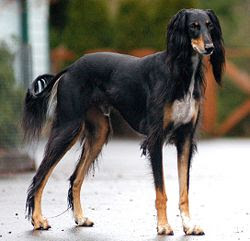
Saluki

Dog of the Bedouin
The Saluki is a sighthound that arguably could be one of the oldest dog breeds. They originate from the Middle East, where they were and still are kept by the nomadic Bedouin tribesmen. Also referred to as the Royal Dogs of Egypt, dogs bearing a striking resemblance to today’s Saluki grace many Egyptian relics.


Appearance

The Saluki is a slim, elegant, and graceful breed. They are longer than they are tall, standing between 22-28 inches at the shoulder, and weighing in at 31-55 pounds. Their coat is short and smooth, with silky feathered hairs on its long ears and legs. Their tail is long and carried in a natural curve with more feathering on the underside. There is a smooth variety, although it is rare, with a slightly coarser fur. The coat can be a wide range of colors including, white, cream, fawn, golden, red, grizzle, tri color (white, black, and tan), and black and tan. Salukis that have a white patch at the base of the neck are known by the Bedouins to have the “Kiss of Allah”, and are especially prized.

History

The name Saluki likely derives from either the former Arabian city of Saluk or from Seleukia of ancient Syria. Carvings depicting dogs that resemble the breed exist from ancient Sumeria and Egypt dating back as far as 7000 BC. There are even stone inscriptions of King Tutankhamen hunting with a pair of these dogs, and several mummified bodies have been found. Traditionally dogs in general are considered unclean in the Islamic culture, but to the Bedouins, the Saluki is considered a holy gift from God. These prized dogs are known as the “Noble One” and allowed to sleep in their master’s tents. They were used to hunt a wide variety of prey such as gazelles, foxes, jackals, and hares, often working in tandem with hawks. Their people held them in such high regard that to protect their feet from the hot sand they were carried to the hunt on camels. Salukis were never bought or sold; instead they were given as gifts of friendship or homage.

Temperament

A Salukis interests can be varied, at one moment they can be quiet and dignified, and in the next playful. They bond strongly with their owners, yet still crave independence. They rarely bark, so when it does occur you should listen to its concerns. This breed does well with older children and with similar dogs. Because of the Salukis hunting instinct it is difficult to have any non-canine pets in the household.

Health and Care

Salukis in general are a healthy breed with a lifespan is around 12 years. They have few genetic diseases, but can be prone to some eye diseases and cancer. Salukis, as with most sighthounds are often sensitive to anesthesia.

Most Salukis can adapt to apartment life, but only if they are regularly exercised. However, they do best with a large, high fenced yard. Regardless of the amount of room at home they need long, brisk walks daily, and preferably somewhere safe to run. They should never be allowed of lead as their prey instinct can easily take over, and they can reach speeds of 40 mph with a lot of endurance. Bred for the extreme heat Salukis thrive in warmer climates.

Salukis are fairly easy to keep groomed, but their longer feathered areas should be brushed regularly to prevent matting. They are average shedders.

Arabian Greyhound


Sloughi

Dog of the Berber
The Sloughi is a sighthound of the Berber people of North Africa, originating in the countries of Morocco, Algeria, Tunisia, and Libya. A rare breed outside its homeland, the Sloughi was traditionally used for hunting and as a guardian.


Appearance

Like all sighthounds, the Sloughi is built for speed, and although they resemble Greyhounds they are not as brawny, even in top physical condition. Often they are described as “looking sad” and have dropping ears and a long tail that is held low. Their coat is short and dense, while colors include different shades of red to sand or fawn, with or without a black mask or mantle, and may have black brindling. Some standards allow a small white patch on a Sloughi’s chest, but it is not desired.

History

Sloughi’s are thought to be an ancient breed of dog, once considered to be related to the Saluki. It is now believed that their closest relative is another African sighthound, the Azawakh. The exact origins of the breed have been lost, but it is thought that their ancestors came from Asia. Written record of them exists from the 13th century, but it is likely they have existed for more than 1,000 years. Like the Saluki, the Sloughi is treasured by its people, in this case, the nomadic Berber. They are treasured members of the family, often they would be decorated with jewelry and their legs were rituality branded by their masters. An owner would go without his own blanket to keep them warm, and they are mourned when they die. They were used for hunting various prey, such as hare, gazelles, foxes, and jackals, often working with falcons. Today, they are still a rare breed outside their homeland. Sloughis have never gained a wide popularity and were almost met with extinction by the turn of the 20th century.

Temperament

Sloughis are a proud and dignified breed, and although they are affectionate towards their owners they will never be subservient. They will always make the first move when meeting someone knew, and do not like to be approached by an enthusiastic stranger. Generally they get along well with children they have been raised with. Indoors they are calm and quiet, and yet outside they are almost entirely different dogs. They retain a high hunting instinct and will always chase anything outside that is smaller than they are. Inside they may be good companions to a housecat they have been raised with, but outside that same cat is fair game. When training this breed one must remember that they are an independent dog, and in some ways difficult to train. Sloughis need a patient handler that they can respect, for it is out of respect that they obey.

Health and Care

Generally a healthy breed, the lifespan of a Sloughi is about 12 years. They are prone to progressive retinal atrophy, and like most sighthounds, are sensitive to anesthesia and certain medications.

A Sloughi is generally not fit for apartment life; they do best with a yard and need daily walks. Ideally they have the opportunity to have a chance to get out and run, but because of their hunting instincts should never be off leash unless it is in a safe, fenced, area.

The short coat of a Sloughi requires very little grooming. They are average shedders.

Thursday, January 14, 2010

Appenzeller Mountain Dog


Appenzeller Sennenhund

The Appenzeller Mountain Dog is a herding breed that originated in Switzerland. They are one of the four Sennenhunds, or Swiss Mountain Dogs, the other three being the Grosser Schweizer, Berner, and Entelbucher. All four of these breeds share the same coat colors, although they very in size. The Appenzeller Mountain Dog is the rarest of the four.

Appearance

A medium breed, the Appenzeller Mountain Dog stands between 19-23 inches and weighs in at 55-70 pounds. They have a short double coat that is tricolor, black or havana brown with rust and white. There should be rust markings over each eye, on the cheeks, legs, and either side of the chest. White should be on the muzzle, feet, tip of the tail, chest, muzzle, and a blaze on the forehead. The tail of the Appenzeller Mountain Dog is curled tightly over the back.

History

It is believed that the Appenzeller Mountain Dog is descended from large Molossers brought to Switzerland either by the Romans or Phoenician traders. Unlike the other Sennenhunds, it seems as if there is a bit of spitz in the breed as well (evident in the curled tail), which adds to a second theory that they are descended from a native dogs. The word Senn is the term for Alpine herdsmen, so a Sennenhund is a “dog of the Senn”. Traditionally the Appenzeller Mountain Dog was used to for herding cattle, as guard dogs, and for general farm work.

Temperament

The Appenzeller Mountain Dog is an intelligent and lively breed that is affectionate with their family, but tends to bond strongly with a single person. They generally get along well with other dogs and non-canine pets, provided they are socialized early. A natural watch dog, most are wary of strangers. Appenzeller Mountain Dogs like to work and be outdoors; if they are left too long without enrichment or a task to do they can turn destructive.

Health and Care

The life expectancy of the Appenzeller Mountain Dog is 11-13 years, they are a healthy breed.

Appenzeller Mountain Dogs are not suited for apartment life. This is a breed that needs plenty of room to run. Daily, brisk walks are a must.

The short coat of an Appenzeller Mountain Dog requires little attention, just a quick brush when necessary.

Basenji


A

B

C

D-E

F-G

H-J

K-L

M-O

P

Q-R

S

T-V

W-Z

China

Japan

Korea

Russia

Thailand

Turkey

Austria

Belgium

France

Germany

Hungary

Ireland

Italy

Malta

Russia

Switzerland

Turkey

United Kingdom

Canada

United States


The Barkless Dog

The Basenji is one of the most ancient breeds of dogs, originating from the Congo and central Africa. It is a unique breed in many ways, and one of their most well known qualities is that Basenji's do not bark, although they do make an unusual yodel sound.


Appearance

Basenjis are small, shorthaired dogs with erect ears and tightly curled tails. Their foreheads often have wrinkles, especially when they are young. Typically they stand about 16-17 inches at the withers and weigh around 22 to 24 pounds. Coats vary from red and white, black and white, tricolor, and brindle, although the brindle is not formally recognized. Still other Basenji variations exist in their homeland.

History


The history of the Basenji (meaning “small wild thing from the bush”) is obscure and for the most part undocumented, however it is generally accepted that it is one of the most ancient breeds, sharing characteristics with other primitive dogs, such as the Dingo and Canaan Dog. They bred without human interference for centuries and dogs very similar to today’s breed were found on the walls and tombs of the ancient Egyptians. However, by the time they were discovered by Europeans in 1895 they were found almost exclusively in the Congo. There they were used in small packs to hunt game, including, antelope, monkeys, and wild cats. Early attempts to bring the breed to England were a failure, the imported dogs dying of disease foreign to their immune systems. It wasn't until the 1930s that a successful breeding stock was brought to the United Kingdom, and then later, the United States. Most of the modern Basenjis today are descendants from these few imports.

Temperament

Basenjis are independent, and yet also bond well with their owners. They are extremely intelligent, can be mischievous, and are known to become destructive if left to their own devices for to long. Most suffer from some degree of separation anxiety. They get along well with most children, but will not tolerate being teased, and will never become a real playmate for them. Normally they will get along well with other dogs, in fact they are happiest with one or two others in their household, but some individual dogs can be headstrong. Basenjis do not like strangers, and will let you know if anything is amiss.

Health and Care

Unfortunately Basenjis are prone to various diseases, one being an inherited kidney disorder called Fanconi Syndrome. Symptoms for this disease do not normally occur until after the age of four, although owners can have them tested by their vet. They also can carry a recessive gene that causes Genetic Hemolytic Anemia, although most Basenjis today are descendants from a line that has tested clean. Among this disorders they are also prone to more common illnesses, such as hip dysplasia, malabsroption, progressive retinal atrophy, coloboma, and persistent pupillary membrane. In general, though, the Basenji is a fairly healthy breed. Their life expectancy is roughly 12 years.

The Basenji can adjust to apartment life, provided they are regularly exercised. They are both active indoors and out, and will do best with at least a small yard.

Basenjis have a short coat and are also known for their cat-like cleanliness, even cleaning themselves with their paws, so very little grooming is needed.

Anatolian Shepherd Dog


Turkish Protector


The Anatolian Shepherd Dog originates from Anatolia, Turkey. Originally the breed was used for guarding flocks of sheep from predators and thieves. The Anatolian Shepherd Dog is still used in its homeland as a guardian.

Anatolian Shepherd Dogs stand between 26-30 inches at the withers and weigh between 90-150 pounds, the females being smaller then the males. In Turkey their ears are often cropped very short, in the case of being attacked by wolves. Their tails only curl when they are alert; generally it hangs low with a slight curl upward. They have a short double coat, and the most common colors are fawn with a black mask. All colors are acceptable on the Anatolian Shepherd Dog and can include biscuit, white, brindle, gray, liver, or red, in a number of combinations.

It is often believed that the Anatolian Shepherd dog has existed in Turkey for as many as 6,000 years old. Several different “breeds” existed in different regions, including the Akbash and Kangal Dog, and therefore it is debated as to whether they are separate breeds or simply one in the same. Currently the Anatolian Shepherd Dog is the only breed recognized by the American Kennel Club (AKC), but the Turkey government is fighting for international recognition of the other breeds through the Federation Cynologique Internationale (FCI). Anatolian Shepherd Dogs, as well as there cousins, are greatly prized for their abilities in Turkey. They often battle wolves when protecting their flocks as well as jackals and even bears. The first Anatolian Shepherd Dogs entered the United States in the 1950s.

Above all the Anatolian Shepherd Dog is a working breed. They are highly intelligent, independent, and highly protective. Anything that is part of its “flock”, which can include family members as well as other pets, will be fiercely protective if need be. This breed requires a dominant owner as well as proper socialization at a young age, however they will never be accepting of strangers. The Anatolian Shepherd Dog is not a breed for the inexperienced owner.

Sunday, December 20, 2009

American Water Spaniel


State Dog of Wisconsin

The American Water Spaniel was developed in the United States; it is believed they originated in the Fox River and Wolf River valleys of Wisconsin. Even today the American Water Spaniel is a little known breed outside of North America.

American Water Spaniels have a curly or marcel coat that is dense and resistant to cold waters. Colors range from liver, brown, and chocolate. They normally weigh between 25 to 45 pounds and stand between 15 to 18 inches. As with all spaniels, American Water Spaniels were originally, and widely still are, bred for hunting.

The origin of the American Water Spaniel can be described as murky at best. There are two theories that are accepted, although which one, if either, is fact is unknown. The first theory comes from Doc Pfeifer, the man credit with the recognition of the breed in the 1920s. He believed the breed was developed by crossing the now extinct English Water Spaniel and the Field Spaniel. Disputers of this idea believe the breed was developed by crossing various breeds including the English Water Spaniel, Field Spaniel, Curly Coated Retriever, Irish Water Spaniel, and possibly even the Chesapeake Bay Retriever. Currently the latter is the more widely accepted theory. Hunters wanted to develop a dog that could function on land as well as in the marsh, yet still small enough to accompany their masters in a canoe or skiff. The American Water Spaniel was widely used in the mid-1800s, and in different times in history has been near extinction, but fanciers of the breed manage to maintain the population.

American Water Spaniels excel at hunting, both as a flushing spaniel and a retriever. They hunt either fur or feather with equal enthusiasm, however they do not have to be hunters to live a happy life. They also make good companion and family dogs. American Water Spaniels should have early socialization with other canines to avoid potential dog aggressiveness.

White Shepherd Dog


Berger Blanc Swiss

White Shepherd Dogs were directly developed from the German Shepherd. Their white coat is considered a disqualifying fault by most major kennel clubs; therefore their fanciers began breeding them independently and strived for them to gain recognition as their own breed. In countries that fall under the Federation Cynologique Internationale (FCI) they are known as the Berger Blanc Swiss, in North America they are most commonly known as the White Shepherd Dog.

Appearance

The White Shepherd Dog is almost identical to the German Shepherd Dog, save their coat color. Ideally they should be solid white, however light cream, biscuit, or tan can also occur. The double-length coat of the White Shepherd Dog can be either medium in length or longhaired.

History

Having developed from German Shepherds, the White Shepherd Dogs share their history. Originally white was accepted as a coat color, however, Max von Stephanitz, the creator of the breed was not in favor of white dogs. Still, it was not seen as a disqualifying fault until the German Shepherd Dog Club of America adopted a colored breed standard in 1959. By 1968, white dogs could no longer be shown in the American Kennel Club (AKC) conformation dog ring events. The United Kennel Club (UKC) allows white German Shepherds, but in 1999 also recognized a separate breed, the White Shepherd Dog. In 2002 the FCI recognized the breed as the Berger Blanc Swiss, which states their country of origin as Switzerland as they were the first to recognize White Shepard Dogs as a separate breed.

Toy Fox Terrier

The Toy that is a Terrier

The Toy Fox Terrier was developed in the United States as a desire to create a smaller Smooth Fox Terrier. Both a toy as well as a terrier, the Toy Fox Terrier can be both a companion and a working dog.

Toy Fox Terriers stand at about 10 inches, and weigh between 4-7 pounds. They are a small breed, but yet distinctly terrier in appearance. Their ears are erect and V-shaped, while their tails are customarily docked. The coat is short and thick, it is white with either black and tan, or only tan markings. Rarely other colors will appear on the Toy Fox Terrier.

The Toy Fox Terrier was developed in the 1930s, its primary ancestor the Smooth Fox Terrier. Through careful breeding that included the English Toy Terrier, Chihuahua, and Italian Greyhound the breed was developed at a smaller size, and these other breeds calmed its disposition as well. First used for hunting vermin, this little dog quickly found its way into homes as a companion as well. Toy Fox Terriers were recognized by the United Kennel Club (UKC) in 1936 and the American Kennel Club (AKC) in 2000.

Although the Toy Fox Terrier is small it has not forgot its terrier ancestors or instincts. They are tough, intelligent, and yet love human companionship. They are not recommended for small children because of their size, however they do well with ones that are older. It loves to hunt if it gets the chance, and therefore does not do well in households with small animals. Toy Fox Terriers are easy to train, even if they have a bit of terrier stubbornness.

In general the Toy Fox Terrier is a healthy breed, but they are prone to legg calve perthes and stifle, both common toy problems. Life expectancy of the Toy Fox Terrier is 13-14 years, and known to stay young throughout its life.

Tuesday, December 15, 2009

American Staffordshire Terrier


AmStaff


The American Staffordshire Terrier, or AmStaff, as it is often known by its fanciers, is a relatively “new” breed of dog. Originally they were intended to be a show strain of the American Pit Bull Terrier when dog fighting became illegal in the United States. Unfortunately, they are commonly identified as a “Pit Bull” and therefore shares many of the myths associated with its cousin the American Pit Bull Terrier. In truth American Staffordshire Terriers can make wonderful pets with the right owners.

In 1936 the Staffordshire Terrier was recognized by the American Kennel Club (AKC), the “American” would not be added to their name until 1972. Their early ancestors were shared with the American Pit Bull Terrier and were bull/terrier crosses brought to the United States from England and Ireland in the 1800s for the then popular sport of dog fighting. When dog fighting became illegal, (in many states this was accomplished by the 1860s) this breed suddenly went in two directions. Many owners wanted to see them recognized by the AKC, and therefore adopted the name Staffordshire Terrier in an urge to divert attention from their dog fighting pasts. When the recognition was achieved some breeders did not agree to the standards placed on the breed by the AKC, and those dogs remained the American Pit Bull Terrier. Even today much confusion remains between the American Pit Bull Terrier and the American Staffordshire Terrier, generally the later tends to be larger both in structure and weight.

American Staffordshire Terriers are loving and loyal companions. They get along well with children, and have a strong bond to their family. As with their American Pit Bull Terrier cousins they have a tendency to be aggressive towards other canines and need to be well socialized when they are pups. Obedience training is a must with the American Staffordshire Terrier.

American Pit Bull Terrier


A Breed of Controversy


Simply the name “Pit Bull” causes many to think of a dangerous, uncontrollable dog, however, the American Pit Bull Terrier is only one of many breeds that seem to be identified by the general public as “Pit Bulls”. They are known as a violent breed that attacks people, but this can and is disputed by many American Pit Bull Terrier owners.

it is true that the American Pit Bull Terrier was breed for, and still illegally used for dog fighting. This in part has added to the many “Pit Bull” myths, as well as the fact that whenever a dog attacks a person it is almost always identified as a “Pit Bull”. In many cases it turns out that the attacking dog is not an American Pit Bull Terrier, or any of its close cousins, including the American Staffordshire Terrier and Staffordshire Bull Terrier. Unfortunately the fact remains that this is one of the most commonly used breeds in the United States for illegal fighting and as vicious guard dogs by irresponsible owners. Owners and breeders of the American Pit Bull Terrier insist that they are not human aggressive and make wonderful pets in the right home.

The ancestors of the American Pit Bull Terrier were bull/terrier crosses brought to America from England and Ireland in the 1800s, and were popular for dog fighting. When bred for fighting the breeder wanted strength and canine aggression, however a lack of aggression towards humans was a must. Any dog that showed aggression towards its owner was destroyed. This created the line of dogs we see today, often aggressive towards other dogs, particularly those of the same sex, however lacking aggression towards humans. When dog fighting became illegal many owners wanted to have the breed recognized and distanced from its history for fighting. In 1936 the Staffordshire Terrier was recognized by the American Kennel Club (AKC), although at the time they were still one breed. Many breeders disagreed to the name change, or the standards set forth by the AKC, and continued to breed American Pit Bull Terrier, and the confusion towards the breeds still remains.

American Pit Bull Terriers are in truth an affectionate and loyal breed. They are eager to please, and have a great fondness for people and their families. While they are well known for their aggression to other dogs, they get along well with children. American Pit Bull Terriers need a firm hand and obedience training is a must, as they can be a stubborn breed and sometimes difficult for first time owners to handle.

American Hairless Terrier


Hairless Rat Terrier


The American Hairless Terrier was once simply considered a variant to its close cousin, the Rat Terrier. They are direct decedents of these terriers, and only recently the American Hairless Terrier began to gain recognition as its own breed.
american hairless terrier
Unlike many dog breeds the exact origin of the American Hairless Terrier is no mystery. In 1972 a hairless, female pup was born in a litter of Rat Terriers. These terriers were owned by Willie and Edwin Scott of Louisiana, she was greatly prized by them, and name Josephine. Josephine was bred and she produced only a single hairless terrier in her first litter, and for several years that was the only pup that gained the hairless trait of her mothers. Then, at the age of nine she had another litter with two hairless pups, on male, and another female. These two dogs would become the foundation for the Scotts breeding program. Through careful a careful breeding program, one that they are still continuing, they succeeded in establishing the American Hairless Terrier.

Unlike other hairless dogs, such as the Chinese Crested and the Mexican Hairless, the American Hairless Terrier has no fuzz or hair on its body, making them a good companion to anyone with dander allergies. They are born with a bit of hair on their bodies; however they will shed this hair entirely by the time they reach six weeks. The skin on an American Hairless Terrier is normally pink, with spots that can vary to include gray, black, golden, or red spots.

American Hairless Terriers are intelligent and inquisitive dogs. They are affectionate and make good companions to adults and children alike. Temperament for the breed is that of any terrier, they bark at unknown sounds, while lively and fearless. American Hairless Terriers do not do well in houses with small pets, although they will normally tolerate cats if they have been raised alongside them.

American Foxhound


Virginia’s Dog


The American Foxhound was developed in the United States and is a close relative to the English Foxhound. They are a very popular dog in the southern states, however very few are registered with the American Kennel Club (AKC), simply because they are a working and hunting breed, most are valued for their abilities, rather than their show quality. The American Foxhound is also Virginia's state animal.

The origins of the American Foxhound can be traced back to the arrival of Robert Burke in the American Colonies in 1650. He brought with him a pack of hunting dogs that became the ancestors for many American Hounds. These dogs remained in the Brooke family for almost 300 years, but were not the only source of the blood of the American Foxhound. George Washington received French Foxhounds as a gift, and he had others that had descended from Brooke's, the crossing of the two were the beginnings of the American Foxhound.

American Foxhounds are quite similar to their English cousins, however they have been developed to be lighter and taller. They have a keener sense of smell and tend to be faster in the chase. They have short coats that may be any color, however the most common coat for an American Foxhound is the tricolor, black, brown, and white are the most common.
The American Foxhound is an affectionate breed, and lovable at home, but they are brave and fearless while on the hunt. They get along well with children, and because of their pack mentality do very good with other dogs, but tend to want to chase any other pets.
American Foxhounds need to have room to run and do not always do well as purely house pets.
Generally the American Foxhound is a healthy breed, as they are not prone to any genetic diseases. Care must be given not to overfeed them, as they do have a tendency to put on weight, especially if they are not properly exercise. The life span of the American Foxhound is normally 10-12 years.

American Eskimo Dog


The Circus Dog


The American Eskimo Dog is a companion dog that was originally bred and developed in the United States. Their ancestors were brought to the United States by German immigrants in the 19th century. A fairly “recent” breed, the American Eskimo Dog was recognized by the American Kennel Club (AKC) in 1994.

American Eskimos come in three sizes, toy (9-12 inches), miniature (12-15 inches) and standard (15-19 inches). They are a Spitz type of dog, which is an ancient dog type, recognized by their erect pricked ears and feathered tails that curl onto their backs. American Eskimo Dogs are always white or white with biscuit cream and have brown eyes, while blue eyes are a sign of poor health or breeding.

No one knows exactly the time and place of when or where the American Eskimo Dog originated, but it believed its ancestor is most likely the German Spitz. The Finnish Spitz, Pomeranian, and Keeshond may have also contributed to its development. Because of its appearance it has been suggested that the Samoyed was also included in the bloodline, but this is not widely accepted. In the early 19th century these white dogs began appearing in the communities of German immigrants. Originally they were known as the American or sometimes German Spitz, but when through the name change sometime around WWI. The bred gained popularity as a circus dog before it became a beloved house pet. American Eskimo Dogs were excellent performers, and the first dog breed to walk the tight rope.

In most cases the American Eskimo Dog is a healthy breed, on average they live between 12 to 14 years, but some have been known to live longer. As with most dogs smaller breeds seem to have a longer life span, so take this into consideration when looking into the sizes of the dog. This bred does, however are often severely allergic to fleas, a single flea can cause frantic scratching and gnawing to their skin. Care must be taken with their coats; an American Eskimo Dog should be brushed with an undercoat rake at least once a week.

English Coonhound

It has been said that the history of the English Coonhound is the history of all coonhounds, which is true, save that of the Plott Hound, all coonhounds have a common ancestry. The English Coonhound originated in the United States, its closest ancestor being the English Foxhound.

Three groups of foxhounds were imported from Europe which were the foundation for the first coonhounds, in 1650 by Robert Brooke, 1742 by Thomas Walker, and in 1770 by George Washington. While it is true that these were European dogs it was the Americans and the land that created the hounds we see today. The dogs had to adapt to the rougher terrain and to the game of the colonies, including raccoon, opossum, cougar, and bear.

Colors of the short coat of the English Coonhound can vary, including redtick, bluetick, tricolor ticks, and a wide variety of other colors including, reds, white, black, and lemon shades. These color variations hold another part of coonhound history. In 1945 tricolor fanciers succeeded in separating them into another breed, known as the Treeing Walker Coonhound, a year later the blueticks also separated into the Bluetick Coonhound. At the time of the split it was simply the color that separated the breeds, but in time each has become more distinctive. Their color variations are still found in the English Coonhound, however.

English Coonhounds are energetic dogs, highly intelligent and make excellent hunters. They are fast and competitive coonhounds, and yet devoted to their families and make good companion dogs. Living indoors does not bother them; however they do best with older children. Make sure you socialize them to other dogs at a young age, and never let them off leash outside; a scent could send them off running. Of course, English Coonhounds have a strong instinct to tree smaller animals.

Carolina Dog

American Dingo

The Carolina Dog is a wild dog found in the United States. Although this breed is now being domesticated and kept as a pet it can still be found in the forest and swamps of South Carolina and Georgia. It is believed that the Carolina Dog was brought to North America across the Bering Straits by Asians 8,000 years ago.

Carolina Dogs resemble small Dingos; they are rugged dogs with a slight resemblance to sighthound breeds. The breed has erect, high set ears and a distinctive “fish-tail” which they carry in various positions. They have a short, yet thick coat, that has longer guard hairs on the neck, withers, and back that will stand up when the dog is aroused. Colors can vary, but the most common is a deep red ginger with paler markings. Lighter shades of red are not uncommon, and other colors include white, tan, beige, yellow, and red sable. Above all Carolina Dogs look like a wild breed, and more than capable of surviving in the wild.

The history of the Carolina Dog is one that is still being studied as well as debated. Dr. I. Lehr Brisbin Jr., a Senior Research Ecologist at the University of Georgia came across a Carolina Dog while working at the University’s Savannah River Site. Brisbin was startled by this dogs resemblance to Dingos, and upon visiting the local shelter found more of these dogs existed. Many of the dogs have now been removed from the wild for studies, and early tests, including DNA show that this is indeed a very ancient dog. Further tests will hopefully begin to give us a better insight on where the Carolina Dog came from.

Carolina Dogs are kept as pets, and have been for sometime in the southern States. They make very loyal companions, and get along well with children. Carolina Dogs like to be part of the “pack” and will want to be included in family activities. Like many other breed that retain close ties to the wild this breed can be independent and shy around strangers. Carolina Dogs should be well socialized at a young age to help it bond with humans.

American Cocker Spaniel

The American Cocker Spaniel, evolved directly from Cocker Spaniels imported into the United States from the United Kingdom. The two were bred for different looks and qualities, and by the 1930s the American version differed so much from the English that the two were given separate breed status.
american cocker spaniel
American Cocker Spaniels weigh between 24 to 28 pounds and at maximum stand at 15 inches. Their long, silky coats come in both a solid (black, tan, chocolate, and red, among others) and particolors, which can be any of the solid colors with white. There are also tricolors, and a rare roan, which are colored hairs that are intermingled. One of the American Cocker Spaniel’s, and its English cousin’s, most well-known feature is their long feathered ears.

Originally the Cocker Spaniel was bred as a gun dog, although the American version rarely participates in the sport now. The name “cocker” derives from its ancestors being bred to hunt woodcock. Although some are still bred for field work in the United States, most are now family pets and companions. The American Cocker Spaniel has been a popular breed since the 1940s; however the breed has declined in recent years.

Most American Cocker Spaniels make excellent pets; they are an outgoing, trusting breed that longs to please. Unfortunately, due to the high popularity and demand of this dog in earlier years they have suffered from an extensive amount of inbreeding. This inbreeding has brought out both a fearful and aggressive behavior that breeders are now working to eliminate. As with all breeds, care should be taken when looking for an American Cocker Spaniel breeder.

The inbreeding of the American Cocker Spaniel has also caused them to be susceptible to a wide variety of illnesses, the most common being ear and eye infections. They also suffer from autoimmune disorders and hip dysplasia.